
Defrag from Windows Vista’s Command Line. Executive Summary: You might not be content with the limited functionality of Windows Vista's new GUI defrag tool. For more options, turn to the command- line defragger, Defrag (defrag. We outline the tool's various switches and capabilities for you. In fact, it seems as if every new Windows version comes with a brand- new defrag tool, and Windows Vista is no exception.
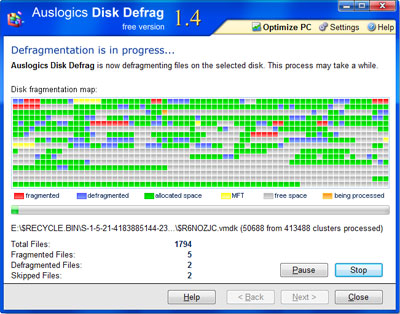
At the prompt, type in this command: defrag c: -a -v. Using our legend from above, this means where going to display an analysis report of the c. Although you don't get much feedback in Vista's Disk Defragmenter user interface, the Defrag command line tool is still alive and well and is more than capable of. Auslogics Disk Defrag Free comes with a command line tool, 'cdefrag.exe'. Request UAC (only for Windows Vista).-a: Analyzes specified disks.-o.
Vista’s GUI- based defragmenter has taken a lot of heat for its taciturnity: Whereas previous GUI defraggers offered a graphical representation of your disk’s used and free spaces, Vista’s GUI defragger merely asks that you trust in its effectiveness and not worry about the details. However, even if the tool is doing a good job, I prefer to know what my system is doing. As is so often the case, it did.
Invoke the command as follows: defrag - a - v The basic report displays the size of the largest block of free space and the overall percentage of fragmented files, followed by a line of advice about whether you should defragment the drive. The addition of - v adds about 2. NTFS’s Master File Table (MFT), the total number of fragmented files, and so on. For example, defrag C: That command performs a quick, simple defragmentation that merely attempts to bring together fragments that are smaller than 6. MB. The reason behind that limitation is that you won’t see much performance impact in joining monstrous hunks of data, compared with joining smaller fragments. For example, sequentially reading a file broken into ten 5.
MB fragments would certainly be slower than reading one 5. MB chunk, but not by much.
For more complete control of defragmentation in Windows 7, you can use the command-line defrag¬mentation tool, Defrag.exe, from an elevated command prompt. Using the options available from the command line version of the Windows 7 defragmentation utility you have much more control over the maintenance of your storage. If you are using Disk Defragmenter to defragment a volume and you run the defrag command at a command-line.
Defrag.exe is a command line tool included with Windows, which is quite useful when wanting to perform a scheduled defragmentation of the hard disk. Disk Defragmenter is a utility in Microsoft Windows designed to increase access speed by rearranging files stored on a disk to occupy contiguous storage locations, a.
But consider reading that same file as 5. MB fragments. The drive’s read/write head would be dancing all over the platter!
Then just add the - w option, as in defrag C: - w Of course, that job will take longer—much longer, in some cases. When I tried defragging my 1. GB C drive with the - w option after running Vista for nine months, the procedure took four hours. But, again, if “sleek is what you seek” defragging- wise, then –w is the way.
Unfortunately, the GUI defragger refuses to attempt a defrag if the drive has less than 1. The command- line defragger, however, offers the - f option, which forces a defrag even if the drive doesn’t have that much free space. Now, I’m happy this option exists, but I would use this option only in dire circumstances.
I’d hate to try to defrag a drive full of important information, only to find that the defrag process isn’t so reliable without a lot of free space. Armed with this information, I’ve turned off the out- of- the- box scheduled defragmenter, and built my own heavy- duty defragger by scheduling the command defrag - c - w Give Vista’s Defrag tool a try. After all, a little more speed never hurt anyone.
Windows 7 Defrag from command line does not work. Hi,Could you defrag as below method: 1. Open Disk Defragmenter by clicking the Start button. In the search box, type. Disk Defragmenter, and then, in the list of results, click. Disk Defragmenter. Under Current status, select the disk you want to defragment.
To determine if the disk needs to be defragmented or not, click Analyze disk. Administrator permission required If you're prompted for an administrator password or confirmation, type the password or provide confirmation. Once Windows is finished analyzing the disk, you can check the percentage of fragmentation on the disk in the. Last Run column. If the number is above 1.
Click Defragment disk. Administrator permission required If you're prompted for an administrator password or confirmation, type the password or provide confirmation. For more information, please read this article: Ways to improve your computer's performancehttp: //windows.
TC=windows- 7. Meanwhile, read this article: Defrag from the Command- Line for More Complete Controlhttp: //technet. Karen Hu. Tech. Net Community Support.


/http%3A%2F%2Fexnol.com%2Fwp-content%2Fuploads%2F2008%2F07%2Fmy-computer-drive-icon-vista.jpg)
/http%3A%2F%2Fdownloads.windowstheme.ru%2Fimages%2Fthumb_windows_vista_vs.jpg)
/http%3A%2F%2Feastchulavistahomes.com%2Fwp-content%2Fuploads%2F2017%2F03%2Fcortebelmarina-1.jpg%3F6f57f7)
/https%3A%2F%2Fi.ytimg.com%2Fvi%2FcokepnuxmOM%2Fhqdefault.jpg)